
Is a Sprayable Ceramic Coating a Real Ceramic Coating?
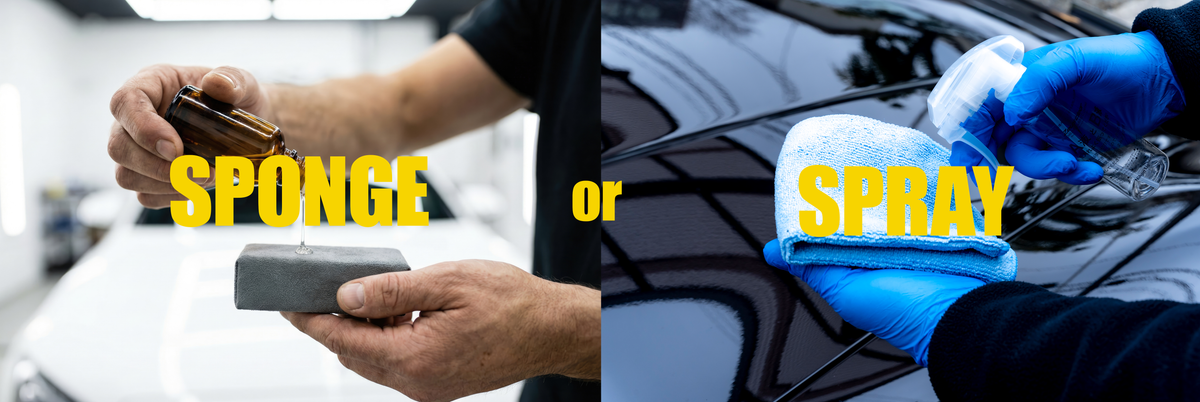
There's a belief in the detailing world that goes roughly like this: a real ceramic coating comes in a small bottle, gets dripped onto a suede-wrapped foam block, and gets worked into the paint panel by panel. If it comes out of a spray head, it's a topper. A booster. Consumer stuff.
So when people hear SILAZANE50 is sprayed onto a microfiber and wiped on, a reasonable number of them conclude it can't be a real coating.
We understand that reaction better than most. Nihon Coating started as a sponge coating company — and we still sell that product in Japan today.
We didn't replace the sponge from the outside
This matters, so we'll be direct about it: we are not a spray brand arguing against a category we've never worked in. We built the sponge product. We manufactured it, sold it, trained people on it, and handled the support calls when it went wrong.
Which means we know exactly what it does well — and exactly where it fails:
- The leveling window. A film laid down by hand has to be evened out within a minute or two, or it cures into high spots that can only be polished off.
- The environment sets the rules. Heat and low humidity shorten that window without warning. Cold stretches it. Direct sun makes it unpredictable.
- Skill decides the outcome. Two people, same bottle, same car, different results.
- The cure is fragile. 12 to 24 hours with no water contact, and one unexpected shower can compromise the job.
None of that made the product bad. It made the product demanding — and it meant a genuinely excellent coating was only excellent in trained hands.
So we spent years developing a chemistry that didn't have those problems. Not a lighter, cheaper version of the sponge product. A different reaction.
Where the "spray means cheap" belief comes from
The shortcut people are using isn't stupid. For years it was basically accurate.
Sprayable paint products were, overwhelmingly, spray waxes, SiO₂-infused detail sprays, and ceramic "toppers" — thin, diluted, wiped on in five minutes and gone in eight weeks. Meanwhile every durable coating on the market shipped with an applicator block, because it had to.
So the market learned: sponge = serious, spray = cheap.
That described a moment in chemistry, not a law of nature. And it confuses a delivery method with a product class.
The sponge was never a quality feature
It was a workaround for a limitation — ours included.
Conventional SiO₂ coatings are a silica resin in a solvent carrier. They cure by evaporation: the solvent flashes off and leaves the resin behind. That only works if the product is laid down as an even wet film of the right thickness, then leveled before it sets. You can't achieve controlled film thickness by spraying and wiping. You need an applicator block that holds product and lays it down evenly, and you need to level it fast.
The sponge exists because the chemistry requires film control. That's the whole reason.
So the real question was never "was it applied with a sponge?" It's "what happens to the paint after it's applied?"
What actually makes a coating a coating
A real ceramic coating has to do three things a wax or sealant cannot:
- Form a permanent inorganic network — a hard, glass-like layer chemically bonded to the clear coat, not a soft layer resting on top of it.
- Cure irreversibly. It doesn't wash off, dissolve in degreaser, or soften in summer heat. Removing it means abrasion.
- Undergo a real curing reaction — which is why serious systems ship with a hardener.
None of the three mention how the product got onto the panel.
SILAZANE50 against that test
SILAZANE50 isn't SiO₂. It's polysilazane — a silicon-nitrogen backbone that reacts with moisture in the air and converts into a dense Si–O–Si glass network bonded directly to the paint. Not a resin drying onto the surface. A chemical conversion happening on it.
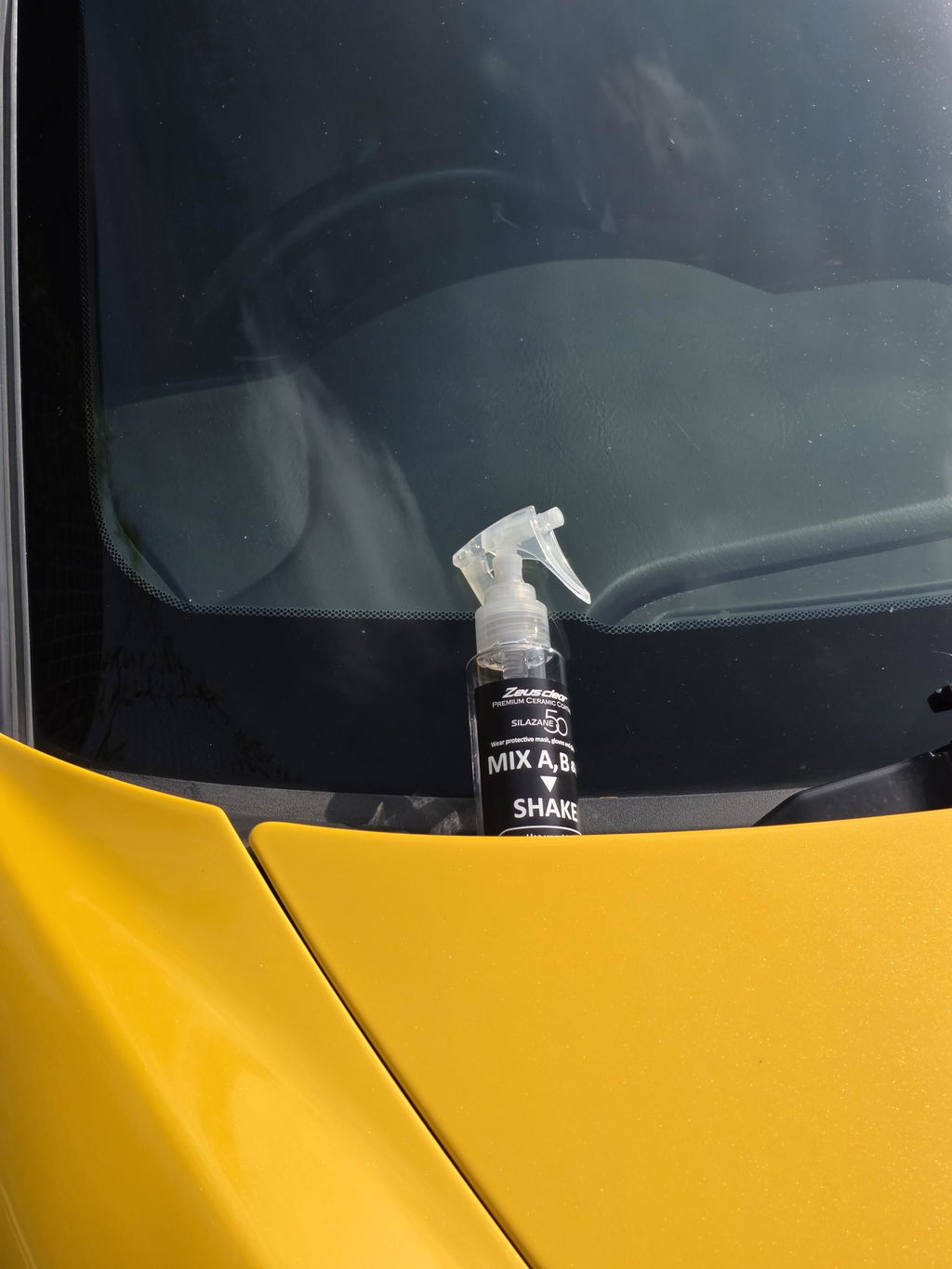
And it ships as a three-part system: Liquid A and Liquid B (the base coat liquids) mixed with Liquid C, a dedicated hardener. All three go together before application. Nobody puts a separate hardener in a bottle of spray wax. A topper has nothing to harden.
Because polysilazane doesn't cure by solvent evaporation, it doesn't depend on wet-film thickness. Nothing to level. No applicator block, no leveling window, no clock. Spray to microfiber, wipe in straight lines, done.
We didn't remove the sponge to make the product cheaper. We removed it because we spent years building a chemistry that no longer needed it.
That's also why high spots largely stop being a threat — not because the coating is thinner, but because there's no film sitting on the paint waiting to be evened out. And why it's rain-ready in 30 minutes and keeps curing even if it rains: moisture is what it reacts with.
The evidence
- Nihon Coating has been a coating manufacturer since 1993. Not a marketing brand licensing someone else's formula — over thirty years of developing the chemistry ourselves.
- The three-part system is the tell. Liquid A, Liquid B, and a dedicated Liquid C hardener. Toppers don't ship with a hardener, because a topper has nothing to harden.
- Alex Palou, four-time IndyCar champion, is the brand ambassador. Drivers at that level don't attach their name to spray wax.
- Over 500,000 users in Japan, and Minkara's "Best Liquid Spray Coating" award.
- Our original sponge coating is still on sale in Japan. We didn't discontinue it to force people onto SILAZANE50. Both products work. One of them just doesn't require you to be an expert.
The point
A sponge tells you a coating cures by film thickness. It tells you nothing about whether the coating is any good.
Judge a coating by what it leaves bonded to your paint — the chemistry, the cure, the hardener, the durability. SILAZANE50 answers all four. We know, because we spent years on the other side of the problem first.
Pro results. Impossible to mess up.